Showing posts with label encouragement. Show all posts

Apr 17, 2012

Thoughts on Editing


I've been working alot in Lightroom this week, trying to get more familiar with it, and developing a workflow. I have also selected a few photos and worked for a long time on them, trying to find good editing style for me.


I like photos that have bright, vibrant colors. Having a photo completely in focus is a must for me, and I really try not to crop off limbs. I want my photos to look real, not all hazy and dreamy, but also not over-edited.

I really admire photographers who do not edit. For one thing, they don't have to spend nearly as much time processing, and they also can spend more time learning how to use their camera to the best of their ability.
It is my goal to get everything right in camera....white balance, focus, cropping, and other things, like making sure there is nothing I don't want in the photo. 

Look at the photo below... 
In the before version, you can see the tip of a red scooter handle right next to his head. I really didn't notice that when I was shooting the photo, but when I went in to edit, it bothered me. I tried to edit it out, but it kind of failed (as you can see :P). I want to notice those kinds of things, and fix them before I take the photo.


Anyway, that was a little bit rambling and I don't know if you got anything out of it. 
Oh well. Enjoy the photos!

Apr 10, 2012

HDR Effect?


Do you remember my post about HDR?
Well, since then, I've doing more researching and reading about HDR.
And I've found out how to simulate the HDR look in Lightroom.

I took some photos of beautiful sunsets while on a trip last week,
and I decided to try something.

 You see this photo? The sky is a lovely color. but the waves are so dark...what if I lightened the photo so that the waves are exposed properly...?


Ta da! But look at the poor sky. Washed out. :( So much for that.


But then I remembered something. Lightroom has this awesome tool called "adjustment brush".
You can set exposure, clarity, sharpness, saturation, etc, and then "paint" it on the photo wherever you want it. 

So:
I took the adjustment brush and lowered the exposure just a tad. 
Then I painted over the top quarter of the photo, where the sky is. 
See? It is darker. The photo is way more balanced, and it has an HDRish look to it!


Isn't that awesome!?

Naturally, I went crazy with it, and had a ball editing these next photos. :D


Those stars made my day :)

Okay, now you go try! It isn't hard. If you don't have Lightroom, don't despair. Look around a bit, and you might find other options. I've heard good things about GIMP, a free photo editing program. 

I'd love to see your edits! 

(Feel free to leave a comment with a link. :))

Mar 27, 2012

HDR: an Experiment

I've been interested in HDR (High Dynamic Range imaging) Photography for a while.
There are some great HDR images out there, and the technique is very unique. 

Here are a few professional HDR images (all link to a post):

by Gavin Phillips
by Leonardo Riano
by Nicholas Moeggenberg
by James Brandon
by MorBCN
After browsing around and reading some tutorials, I decided to give it a try.
I needed 4 things:
  1. A camera
  2. A tripod
  3. A program that did HDR photo merges (Corel PaintShop Photo Pro X3)
  4. Something to photograph
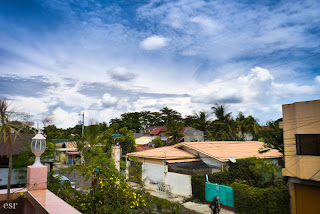
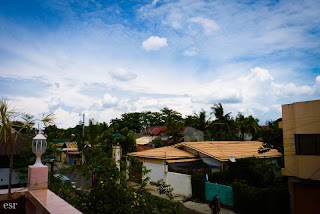
Well, I ended up just photographing my neighborhood. HDR is a more dynamic kind of photography. It shows closer to what the human eye sees, and captures more of the range of colors and light.

In this first photo, the sky is a lovely blue, and the clouds are fluffy and white. But the rest of the neighborhood is a bit underexposed, and the light is kind of "murky" there.


But....voila! In this photo, both the sky and the neighborhood are properly exposed! Cool, right!?


But, you say, HOW in the WORLD did you do that? 

It is actually quite simple.
I set my camera up on the tripod.
I turned the Aperture Priority mode on.
I correctly exposed for the sky.
Then I shot about 7 different exposures.
In some of the photos, the sky is way over exposed, but the neighborhood is lovely.
In others, the neighborhood is way underexposed, but the sky looks great.

Then I took those photos and imported them into Corel PSP, a program that is somewhat like Adobe Photoshop.
I clicked on "HDR Photo Merge" and loaded about 7 photos.
I fiddled with a few settings, and got this photo. Amazing.


(Basically all the program does is merge the images together.)

Here is another HDR photo merge that I have done (in color and black and white):


HDR is used mainly for landscape and cityscape photography. There are great things about HDR, and not so great things. If you look at the clouds in the comparison photos above, the clouds are much clearer in the original photo than in the HDR. That's because clouds move. I took 7 images and merged them together, but the clouds moved slightly in each shot, so they are blurry in the final product.

In my photo, it looks a little weird and unprofessional, but some photographers are very talented at using the moving clouds to their advantage, like in the last example I gave. (by MorBCN)


So, HDR photography is amazing. I enjoyed experimenting with it, and look forward to using it occasionally.
It is definitely not a technique that should be used all the time, but there are a few instances where it can be very well used. Why don't you give it a try?!

Feb 20, 2012

What Camera?


Having a hard time deciding what kind of camera to buy? I wrote this article a few months ago for my photography class, and decided to post it here.

There are four main types of cameras: Digital SLRs, Superzooms/Bridge Cameras, Point and Shoots, and Camera phones. They all have their pros and cons, and I’ll be comparing them here.

When you are considering buying a camera, cost is a huge factor. Can you afford a professional camera, or is your budget more suited to a point and shoot? Obviously, the nicer camera you get, the more expensive it will be. It all depends on how much you are willing to spend, and also what deals you can find! Sensor size is important to look at when you are buying a camera too. The larger the sensor size, the more pixels a camera takes in per photo. That results in (for the most part) a nicer photo, especially in extreme light conditions. But camera with a larger sensor size will be more expensive. There is always give and take!

Let’s also talk about audience…what cameras appeal to certain groups of people. What professional photographer is going to go buy a camera phone to take fancy portraits or landscape shots? Pretty much no one I know of. Professionals are out to buy professional cameras. And vice versa; if someone wants a camera to take a few casual photos on their vacation, are they going to go out and buy a professional SLR that costs a load of money? Probably not. Someone like that would be more likely to buy a point and shoot, or even a phone with a camera. Bridge Cameras (aka Superzooms) appeal to the amateur photography enthusiast who doesn’t want to invest in an SLR and a few lenses. So if you are a professional photographer, you will probably have a much nicer camera than someone who is an amateur. Also, professionals sell their work. They take photos for people and make money. That helps pay for what they are spending on their cameras and equipment.

Next is convenience. Probably the most convenient phone out there is built into your cellphone. It is a given that your phone’s camera will not take pictures as well as a SLR. But you probably have your cell phone with you most of the time. You will be much more likely to capture moments that don’t wait for you to run and get your camera. Of course, the quality won’t be as good. Every camera has pros and cons.

This table is a comparison of the pros and cons of the four different kinds of cameras I've mentioned here: (click on the image to enlarge, or open the table in Skydrive here!)

Click to enlarge

Hope this helps! 

I know I had a hard time deciding on my first camera, and it would have been helpful to read something like this. 

And my word of encouragement is: whatever camera you own, learn to use it. Often it is not camera that makes the picture good. I've had people ask me, "Does your camera take good photos?" and I have to say, "Only if you know how to use it!" Well, I guess if you put it on auto....but that's a different subject altogether. :)

Let me know what your thoughts on this are! I'd love to hear them.


| Disclaimer: This post is in no way affiliated with any company, and these are my opinions and my opinions only. Not to be mistaken for professional advice ;) |

Dec 31, 2011

2011 - Favorites


A very joyful and blessing-filled New Year to you all, one where you grow in the grace and knowledge of our Creator!

Therefore, if anyone is in Christ, he is a new creation; the old has gone, the new has come!
2 Corinthians 5:17

Happy New Year!

Dec 14, 2011

Lunar Eclipse

As some of you may (or may not) know, there was a total lunar eclipse 4 days ago, on December 10th. It was in the southern hemisphere, so it wouldn't have been visible to those of you in the US :)
I didn't stay up to watch it all :P
But I got a few neat photos!

8:18pm, 12/10/11, ISO 80, f/2.8, 30.0 sec
 The moon was super bright, as you can see. Well, I took that photo on a long shutter speed, so it wasn't quite that bright. But it was bright, believe me!

8:20pm, 12/10/11, ISO 80, f/3.2, 30.0 sec
 AMAZING stars!
8:28pm, 12/10/11, ISO 80, f/4.4, 1/800 sec
 See, the above photo was taken with a 1/800 sec shutter speed. That's FAST! If you tried to take a photo in normal daylight with that shutter speed, the photo would be super dark.
8:29pm, 12/10/11, ISO 80, f/4.4, 1/500 sec
LOVE IT! :D

 Around an hour later:
9:23pm, 12/10/11, ISO 80, f/4.4, 1/80 sec
Oooh....the eclipse has started....:)
9:24pm, 12/10/11, ISO 80, f/4.4, 1/125 sec
9:25pm, 12/10/11, ISO 80, f/4.0, 1/6 sec
The above photo is pretty awful, but if you look closely, (or click on the photo to make it bigger!) you can see the whole outline of the moon. Amazing, hm?! I took the photo on a slower shutter speed so you can see the whole outline, but the "lit" part of the moon is very bright. 

I had fun :)
Taking photos at night is a challenge, (I NEED A TRIPOD!) but it can be very rewarding.

Sweet Shot Day

Linking up at my3boybarians...Sweet Shot Tuesdays :)